|
ROSSETTI
Period & Fantasy Influenced Couture Wedding Gowns &
Professional Quality Ballet Costume
Over 25 years of experience in Film, Theatre and Couture Bridalwear
Based
in the UK, Rossetti Costumes
and Bridal Gowns are created by a highly experienced
couturier/costumier.
Theresa Blake (née Jones) trained at Wimbledon School of Art in period costume cutting and construction for film, television and the West End stage (ballet and opera). Combining this early training with her later experience in several major bridal houses, couture bridalwear design was inevitable. Today the resulting bespoke quality wedding gowns, corsets and ballet costumes are of
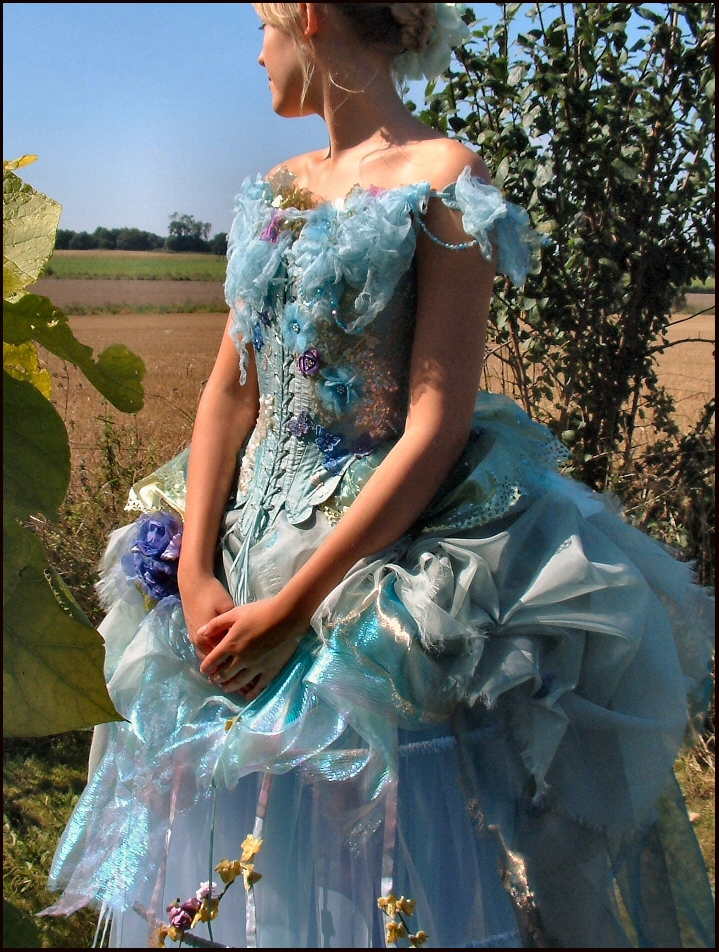
an extremely high standard, perfect finish, and fit like a glove. Enchanting designer wedding dresses and bridal corsets, inspired by Pre-Raphaelite art, Medieval and eighteenth century historical fashion, can be commissioned from a designer who also produces totally unique one-off contemporary designs. Theresa divides her time between designing/ making couture wedding gowns, and constructing costume for prestigious ballet competitions (such as the Genée International) and for musical theatre.
|
 |
|
Credits include costume-making for the Royal Shakespeare Company and Oscar-winning film and television costumiers, Angels. Theresa has worked on headdresses,
jewellery and tutus for several ballet companies (including The Royal Ballet, English National,
Scottish and Moscow Classical Ballet); and has made bridal gowns for top couture
designers including Basia Zarzycka and Ritva Westenius. The potential of positions with Vivienne Westwood and Elizabeth Emmanuel in the late 1990's inspired her to establish the Rossetti label and follow her own inspirations.
|
 |
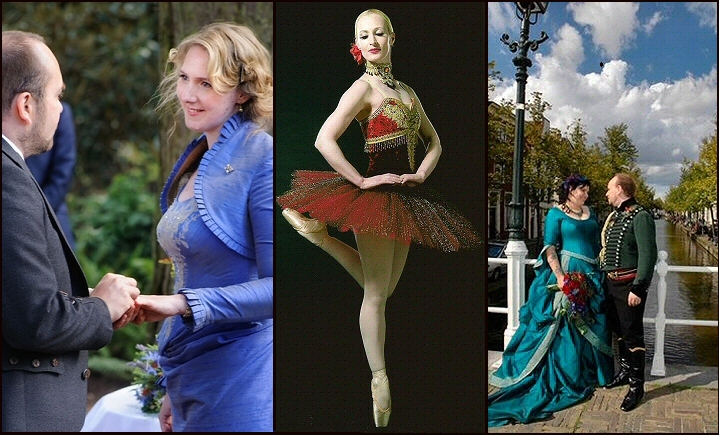
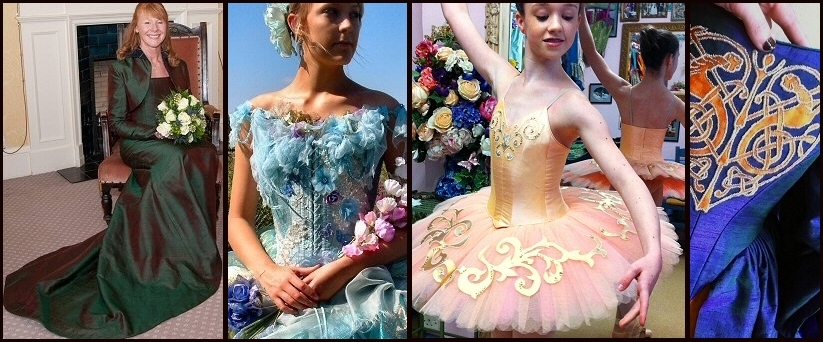
Most bridal clients approaching Rossetti are looking to commission an alternative (often coloured), one-off and made-to-measure wedding gown. They usually wish to follow an existing Rossetti design, possibly varying fabrics and/or colours. Or, alternatively, they wish to follow their own inspirations and enthusiasms (often gathered over months and years), in combination with our advice and experience, to evolve a totally unique wedding dress of their own. Bridal orders often break down into one of several categories (shown on menu, above, left), namely, couture wedding gowns inspired by the Pre-Raphaelite period of art and by Medieval period costume; corsets and wedding dresses inspired by 18th and 19th century historical costume, paintings of the period and films set in that era; or contemporary designs - possibly with period influences, and inevitably with a distinct use of colour. Tutu commissions usually come from dancers (their teachers and mothers) who are attending festivals, competitions such as the All England and from individual ballet companies. Again, they either request a copy of an existing design, made-to-measure, or a totally new style - often for a particular role, or an exam such as the Solo Seal performance.
**Rossetti is now booking into late 2010/2011.**
**In the very near future Rossetti is likely to only design and construct ready-to-wear tutus to specific stated measurements. Please contact at your first opportunity if you are likely to need a made-to-measure costume, constructed to a specific design in 2010/11.**
**Rossetti was asked to provide design sketches for a book, "The Real Alice in Wonderland" (top right), about the life of Alice Liddell, published in the USA to coincide with the release of the Tim Burton film. The book will be available in Barnes and Noble from early March. The UK launch is in July. See the 19th century category for more information.**
**Rossetti tutus are on display at "Fonteyn Dancewear Ltd", Elstree, Herts.**
**New Rossetti stockist**. From 2010 Cocoa Designs, right, will be stocking several unique Rossetti corsets, exclusive to their Cheltenham showroom. They will be combining them with their own skirts to make a complete outfit. Modelled photos coming soon. (Cocoa: 01242 233588)
|
 Rossetti corsets at "Cocoa", above |
"She was enveloped by her clothes as if by the delicate, distilled apparatus of an entire civilisation." Marcel Proust (1871 - 1922)
Photography on Tutu index page by kind permission of Harlow Ballet and Moodboard.com by David Ryle.
| Whatever
your requirements - for an alternative wedding gown, period or dance costume - for further
information please contact: |
Please note, prices quoted for construction of specific designs do not necessarily relate to the commission fee paid by that particular client. Time may have moved on since the construction of the corset, gown or tutu shown; construction and fabric charges may have changed (up and down) and, most importantly, it is a little impolite to reveal what a client has paid! I owe a massive debt of thanks to many people - especially those who kindly let me use their photos on this site.**Attempts are made to contact all those whose images are used within this site, for permission. If Rossetti has not been able to contact you, and you are unhappy about your photo being used, please contact us IMMEDIATELY**
Huge thanks to (for photos, modelling and assistance beyond duty!): Andrew Blake, Rachel Batterham, Claire Yaxley, Joanne Chilves,
Cat Beech, Candice Chin A Teh, Ruth Markham, Lavinia Hays, Gillian Harris, Anita Quayle, Michelle Turner, Elanor Churchill, Leslie Barnes, Nicky Dobson, Jane Pearce, Jane Wallace, Michaela Richardson, Amy Jackson, Mandi and Rebecca Field, Sarah Farnhill, Clare Hubble, Cathy Houghton, Emily Cole, Charlotte Brown, Lara James, Jane Gilmour, Crafty Arty Designs, Elspeth and Ben Hannen, Wendy Cole, Eliza Zen, Karen O'Connor, Tina Kerrigan, Harlow Ballet Association, King's Lynn Town Hall, Wendy White, Victoria Adams, Angela Fox, Pearl Beckles, Edwina Browne, Anna Sawtell, Cheshire Youth Ballet, Angela Evington, Hannah Fogg, Simone Van de Stadt, Kate Young, Marjorie Rogers, Jane Cowood, Jean Gates, Jenni Nolan, Claire Beckles, Zola Thomas, Joanne Parker, Mia and Jeannie, Alice Berry, Sophie Halliday, Hannah Ellis, Candice Stark, Sam and Amber. |
This website, designs and images thereof are all Copyright © 1987 - 2010
Theresa Blake. All Rights Reserved.
Notes From The Designer
It might surprise the man-on-the-street to know that companies such as the Royal Ballet, Royal Opera, Glyndebourne and the Royal Shakespeare company are sources of the highest couture standards - on a par with the top fashion and bridal houses. There is a misconception sometimes, by those who do not know, that "finish" is the difference between fashion and costume trained designers. The cliché about glamerous sparkle on the outside, yet rough on the inside is simply wrong for the part of the theatre world I was lucky to work in. I do not make fancy dress costume!
A trained and experienced cutter knows where to place seams, boning and which combination of interlininings to use to achieve bodices, sleeves and skirts which fit like a second skin without a wrinkle in sight.
Pattern-cutting skills - both on the stand and flat were of great importance when I trained at Wimbledon School of Art. We worked gradually through the centuries in men’s and women’s dress to the modern day. Always we had to strive for the highest quality of finish - from pattern-drafting, via fitting to finishing and trims. We were taught how to cut, fit and construct period corsets and frames to give a gown the perfect silhouette for the period. With the top theatre and film companies these costumes are often made from the most sumptuous satins, silks and laces, imported from all parts of the world. Consider the quality of workmanship needed to be displayed in detail across a cinema screen. Some might argue that the design budgets for performances of this quality are needlessly large, but these costumes were usually destined to last for decades and to enhance the performances of our most elite dancers, singers and actors. At Wimbledon I was fortunate to attend a lecture given by the theatre designer, Yolanda Sonnabend, and to see some of the set models of the then "new" Swan Lake. It was about to be premiéred by the Royal Ballet in early 1987. All these years on, the same production, and no doubt many of those made-to-last costumes, are still performing. Dancers and actors are quick to comment if a costume is likely to affect or inhibit their performance, so you learn to get it right! I learned more couture techniques at the RSC (thank you Norma!) than while working for any bridalwear designer!
With costume, as with wedding dresses, there is a variety of quality, standard of construction and finish available. The local fancy dress hire and "am-dram" society is probably at the bottom of the scale, but is, unfortunately most people's idea of "Costume". In between are the costume re-enactors who may have no formal training in costume-making but may be experts on their own period and take great enjoyment, and much time, love and application evolving their own authentic reproduction costume. At the other extreme, consider some of the stunning period and fantasy costumes in films such as "Orlando", "Dangerous Liaisons", "Elizabeth" and "Shakespeare in Love", or anything by the Merchant Ivory team. These costumes would usually be provided by such costume houses as Cosprop and Angels - teams and individuals who are specialists in accurate cut and reproduction, (and a wonderful source of experience-gathering between terms at Wimbledon).
With my work, the only difference between "costume" and bridal dresses is that costumes do not have a lining directly next to the skin. However, they will still be formed of a combination of top fabrics and interlinings which might add up to five or six layers. The "inner workings" are more on display with a ballet or period theatre costume and have to have a perfect finish - all seams edged, bones fully encased and safe for the artist to wear. No raw edges or wrinkles here! With my wedding gowns, there is the additional lining next to the skin. Seams have to be easily attainable with theatre costumes - you never know when a dancer might strain a tendon in the twenty minutes prior to performing. Suddenly an alternative cast is dancing and the costume needs to be taken-in in the course of the Prologue! Understudies are not an issue for wedding gowns (!), so dresses are fully lined.
I am desperately lucky to be "allowed" to do what I do. I am still quite surprised that so many other people have tastes which collide with mine (and they can't sew!) Sometimes I consider specialising again - just ballet work; just wedding gowns... but, truth is, I revel in doing both. I think you have to be a little obsessive compulsive to make such an engineered item as a tutu... The whole thing is an obsession and I have more design ideas than there will ever be hours to the day! One way and another, it rarely feels like work.
I am inspired by the sensuousness and flowing lines of Pre-Raphaelite paintings - especially those by Rossetti, Waterhouse, Kate Bunce, and Burne Jones. This, inevitably leads to an enthusiasm for ethereal and elvish Medieval styles. At the other extreme I love the elegance and potential for extravagant embellishment offered by eighteenth century costume. From the stylish charm of an Elizabeth Swann-type wedding dress, via Watteau's famous paintings, to Marie Antoinette's elaborate grandeur, the eighteenth century lends itself perfectly to the most sumptuous style of bridal gown and I go there again and again.
If you have reached the base of this Home Page and are a first time visitor, please scroll back up to the top for connections on the menu to Pre-Raphaelite and Medieval-style Alternative Wedding gowns, Contemporary Couture Bridal Dresses, Period and Modern Corsets, Authentic Period Costume and Classical Ballet Tutus.
|
|